
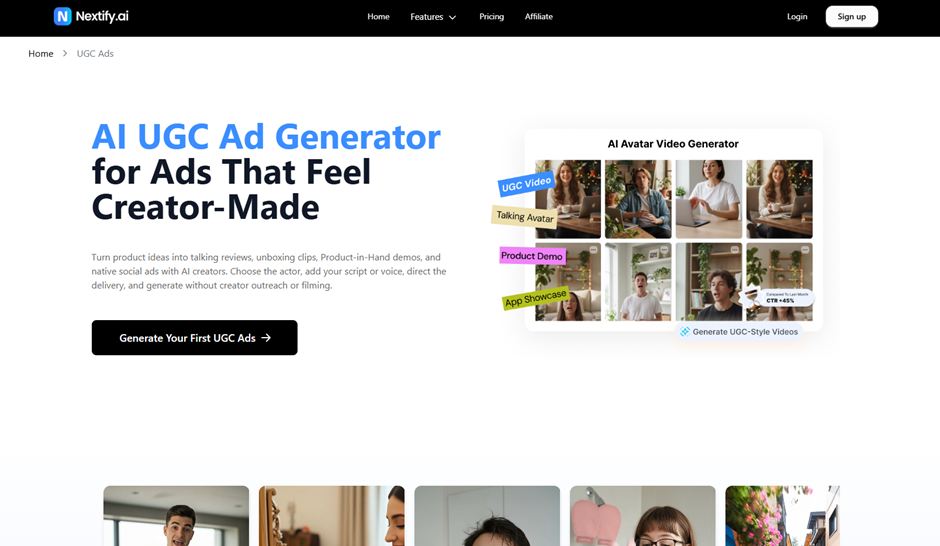
Short-form video has quietly become the backbone of modern advertising. Today, brands are no longer competing solely on visual perfection; they are competing on speed, relevance, and volume. In feeds dominated by highly casual TikToks and Reels, traditional high-production ads often feel out of place. Audiences naturally lean toward “User-Generated Content” (UGC) because it feels informal, personal, and authentic.
However, producing dozens of unique UGC-style videos every week is a major operational challenge. Sourcing creators, shipping product samples, writing scripts, and editing footage can take weeks of coordination and cost thousands of dollars. This logistical bottleneck has sparked significant interest in automated tools. To see if technology could reliably address this problem, I spent a week exploring Nextify.ai to evaluate its capabilities as an AI UGC Video Generator.
Understanding the Technology Behind Modern Video Automation
To understand where video synthesis stands today, we have to look past the basic slideshow generators of the past. Early automated video builders merely placed static images over stock music and paired them with robotic text-to-speech voices.
Modern platforms operate differently. Today’s tools draw upon advanced generative video models—such as Google Veo, Kling, and Alibaba-based models—to synthesize lifelike human movement, realistic voice inflections, and product interactions directly from digital inputs.
codeCode
[Product URL or Script] ──> [AI Scraping & Copywriting] ──> [Neural Video Synthesis (Veo/Kling)] ──> [Finished UGC Ad]
When you use an AI UGC Ad Generator, the system is essentially executing a series of specialized tasks. First, a natural language model analyzes your product’s key selling points to write a script. Then, a deep-learning speech model synthesizes a voiceover with natural-sounding pacing. Finally, a generative video model projects those audio cues onto a digital actor, synchronizing lip movements and facial expressions. This approach moves video production from a physical filming problem to a software-guided formatting workflow.
Exploring Nextify.ai as an AI UGC Ad Generator
Setting up an account on Nextify.ai was straightforward and took less than five minutes. The user interface is cleanly laid out and clearly designed for performance marketers and e-commerce store owners rather than professional cinematographers.
The Workflow and Product URL Scraping
During my testing, I decided to run a practical experiment using a ceramic travel coffee mug. I pasted the product’s online store URL directly into the generator.
The system’s algorithms immediately went to work. They scraped the product page, extracted high-resolution product images, identified key marketing hooks, and compiled a 15-second social media script. From there, I was prompted to select an AI actor (or avatar) and a voice profile from their digital library.
Video Generation Models
One interesting technical aspect of the platform is the ability to select different underlying generation models, such as Kling or Sora-level rendering pipelines, depending on how much computational detail you want to apply to the scene. I opted for a standard vertical format (9:16) optimized for TikTok and Instagram Reels.
The Resulting Output
The generation process took about three minutes. The resulting video featured a highly realistic digital actor holding a 3D-projected rendering of the ceramic mug while reciting the generated script.
The lip-syncing was remarkably precise in English. The background environment matched a modern kitchen scene, which fit the casual aesthetic of UGC perfectly.
Real-World Use Cases for AI-Synthesized Video
Because automated video tools prioritize speed over cinematic complexity, they are highly useful for specific, high-volume scenarios:
- E-Commerce and Dropshipping Testing: For store owners testing multiple products a week, waiting for physical creators to ship videos is too slow. An AI ugc video generator allows founders to test ten different product concepts in an afternoon to see which angles capture organic interest first.
- Ad Fatigue Mitigation: On paid social channels like Meta and TikTok, ad creatives fatigue rapidly. Performance marketing agencies can use automated platforms to quickly swap hooks, background actors, or voiceover scripts on top-performing offers to extend the lifespan of their campaigns.
- Multi-Language Localization: Scaling a brand internationally typically requires hiring local native-speaking actors. Because platforms like Nextify.ai support dozens of languages, you can translate a single English product ad into Spanish, French, or Japanese with a few clicks, opening up global markets at minimal cost.
Strengths and Limitations of Nextify.ai
No single tool solves every creative challenge. A balanced look at Nextify.ai reveals both practical advantages and clear technical limits:
Strengths
- Remarkable Production Speed: Converting a product URL into a structured video ad takes minutes rather than days.
- Convincing Product-in-Hand Generation: The algorithm does a respectable job of realistically inserting your product image into the virtual actor’s hands.
- Cost Efficiency: The platform offers a free tier to try, with paid plans starting at highly accessible rates compared to the cost of professional design agencies.
Limitations
- The “Uncanny Valley” Effect: While the avatars are highly realistic, they can occasionally feel slightly too perfect. If you watch closely, you may notice a lack of micro-expressions or subtle eye movements, which can look slightly unnatural to a highly observant viewer.
- Complex Motion Artifacts: If your script requires the actor to turn the product rapidly or perform complex physical tasks (like unscrewing a lid), the AI-generated textures around the fingers can occasionally warp or lose tracking.
- Strategic Dependence: The platform executes commands; it does not replace core marketing strategy. If your input script lacks a strong, clear offer, the synthesized output will still perform poorly.
Alternatives and Traditional Methods
When determining how to build your creative assets, it is helpful to look at how different production methods compare:
| Production Method | Turnaround Time | Cost per Asset | Authenticity & Detail |
| Traditional UGC Agencies | 1 to 2 Weeks | $50 to $200+ | High. Genuine human emotion and real-world physical interactions. |
| Manual Editing & Stock Footage | 2 to 5 Hours | Low (Subscription fees) | Medium. Good control, but limited by available stock library scenes. |
| Nextify.ai (AI UGC Ad Generator) | 3 to 10 Minutes | Under $2 (Credit-based) | Medium-High. Fast and customizable, though slightly less unique than a real human. |
Final Thoughts
In the fast-moving landscape of modern advertising, speed and volume are often just as important as high production values. While Nextify.ai won’t replace the deep emotional resonance of a highly talented human actor, it serves as a highly capable assistant for performance marketers who need to ship, test, and iterate on creatives at scale.
If you are an e-commerce brand looking to overcome the creative bottleneck and lower your cost per acquisition, adopting an AI ugc video generator is a practical way to keep your social feeds fresh and your ad accounts active.