
Visual content has become a central component of modern communication. Marketing teams, ecommerce businesses, publishers, agencies, and independent creators are expected to produce a steady stream of images for websites, advertisements, social media channels, newsletters, presentations, and product catalogs. At the same time, audiences expect content to be visually engaging, relevant, and tailored to specific contexts.
This growing demand has placed significant pressure on creative teams. Traditional production methods often require substantial time, coordination, and resources, particularly when multiple concepts, formats, and variations must be developed within tight deadlines.
As a result, AI-powered image generation and editing platforms have emerged as an increasingly important part of creative workflows. Rather than replacing designers or photographers, these tools are often being used to accelerate ideation, streamline revisions, and expand the range of visual assets that teams can explore.
The broader shift is not simply about automation. It is about enabling more iterative, collaborative, and flexible approaches to visual content creation.
Why Teams Need Faster Visual Production Workflows
The volume of content required across modern digital channels has increased dramatically. A single marketing campaign may require social media graphics, landing page imagery, display advertisements, email visuals, blog illustrations, product banners, and video thumbnails.
Producing all of these assets through traditional methods can be resource-intensive. Creative teams frequently face challenges such as:
- Limited production capacity
- Tight campaign timelines
- Frequent revision requests
- Multi-channel formatting requirements
- Seasonal and regional content variations
AI-assisted workflows help address some of these pressures by allowing teams to generate concepts quickly, test visual directions earlier, and iterate on assets without restarting production from scratch.
For many organizations, the value lies in shortening the gap between an idea and a usable visual draft.
Text-to-Image Generation in Modern Creative Work
One of the most widely discussed applications of AI in design is text-to-image generation. These systems allow users to describe a concept using natural language and receive visual outputs based on those instructions.
For marketers and designers, this capability is often used during the earliest stages of creative development. Instead of beginning with a blank canvas, teams can rapidly generate multiple interpretations of a concept and evaluate which directions deserve further development.
Common use cases include:
- Creative brainstorming sessions
- Mood board creation
- Campaign concept exploration
- Visual storytelling experiments
- Presentation and pitch development
The speed of text-to-image generation can help teams evaluate several visual approaches before committing resources to detailed production work.
Importantly, generated outputs are frequently treated as starting points rather than final deliverables. Designers may refine compositions, adjust layouts, modify branding elements, or combine generated imagery with traditional design assets.
This approach allows AI tools to function as collaborative creative aids within existing production processes.
Image Editing and Iterative Refinement
Image generation is only one part of the workflow. Equally significant is the growing role of AI-powered editing tools.
Many creative projects involve modifying existing visuals rather than generating entirely new images. AI-assisted editing workflows can support tasks such as:
- Background replacement
- Object removal
- Style adaptation
- Color adjustments
- Composition changes
- Resolution enhancement
- Visual cleanup
These capabilities allow teams to preserve valuable source assets while exploring alternative creative directions.
For example, a product image originally photographed against a studio backdrop can be transformed into multiple lifestyle environments. A social media graphic can be adapted to match a seasonal campaign theme. Existing artwork can be revised to fit new branding requirements without recreating the entire composition.
The iterative nature of these workflows is particularly valuable. Teams can evaluate several versions of an asset, gather stakeholder feedback, and continue refining outputs through multiple editing cycles.
Rather than viewing design as a linear process, AI editing tools support a more experimental and responsive creative environment.
Reference-Based Workflows and Brand Consistency
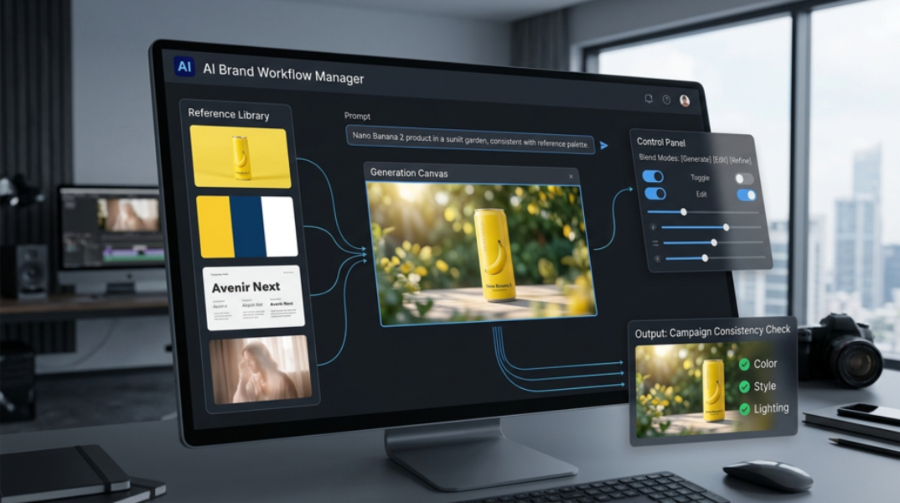
One of the practical challenges of AI-generated content is maintaining visual consistency. Brands typically rely on established visual identities, including color palettes, composition styles, typography systems, and photographic aesthetics.
Reference-based workflows have become an important solution.
Instead of relying solely on text prompts, creators can provide existing images to guide the generation or editing process. These references help establish visual direction and improve alignment with brand standards.
Platforms that support multiple workflow types often allow teams to combine generation and editing methods depending on project goals. For example, resources such as Nano Banana 2 are frequently discussed within the broader conversation around AI-assisted visual production because they illustrate how creators can move between generation, editing, and reference-driven workflows as project requirements evolve.
Reference-guided approaches are especially useful when organizations need to produce new creative assets while maintaining continuity with existing campaigns.
The result is often a more structured and predictable production process that balances creative exploration with brand consistency.
Character-Consistent Content Creation
Character consistency represents another area where AI-assisted workflows are gaining attention.
Many organizations use recurring characters across educational content, marketing campaigns, social media series, and brand storytelling initiatives. Maintaining visual continuity across dozens or even hundreds of images can be difficult using traditional production methods alone.
AI workflows can help creators establish recognizable characters and generate new scenes while preserving key visual attributes such as:
- Facial features
- Clothing styles
- Color schemes
- Expressions
- Artistic direction
This capability supports a variety of applications.
Educational publishers may create recurring instructional characters. Content creators may develop visual personalities that appear across social channels. Marketing teams may build campaign narratives that rely on recognizable figures appearing in multiple formats.
Consistency helps audiences build familiarity with visual content over time, strengthening narrative cohesion across campaigns and content series.
Ecommerce and Product Visualization Applications
Ecommerce businesses face unique content demands. Product catalogs require large volumes of images, often across multiple channels and formats.
Traditional photography remains important, but AI-assisted workflows are increasingly being used to supplement existing assets.
Common ecommerce applications include:
Product Photography Enhancement
Retailers often improve existing product images through background cleanup, lighting adjustments, and visual refinement. These edits can help standardize catalog imagery while reducing manual editing time.
Product Image Variations
Many businesses need multiple versions of the same product image for different audiences, marketplaces, or promotional campaigns.
AI-assisted editing workflows can support the creation of alternate visual treatments without requiring additional photo shoots.
Lifestyle Mockups
Products can be placed into a variety of contextual environments, helping customers visualize potential use cases.
This approach is particularly relevant for furniture, home décor, fashion, accessories, and consumer goods.
Seasonal Campaign Assets
Retail promotions frequently require seasonal variations. Rather than recreating assets from scratch, teams can adapt existing visuals for holidays, regional campaigns, or limited-time promotions.
These workflows allow businesses to expand content production while maintaining alignment with existing product photography strategies.
Marketing, Advertising, and Social Media Production
Marketing teams are among the most active adopters of AI-assisted visual workflows because they often operate within fast-moving production cycles.
Creative concepts frequently evolve throughout campaign development. AI tools can help teams visualize ideas before investing in full production.
Applications include:
Ad Concept Development
Creative teams can generate multiple visual directions during campaign planning. This allows stakeholders to review concepts earlier and provide feedback before significant resources are committed.
Campaign Testing
Alternative visual approaches can be explored quickly, supporting experimentation and creative discovery.
Landing Page Visuals
Web teams often require custom imagery tailored to specific audiences, products, or promotional themes. AI-assisted workflows can help generate supporting visuals that complement broader marketing strategies.
Promotional Graphics
Seasonal promotions, event campaigns, and product launches frequently require new creative assets within compressed timelines.
AI tools can accelerate early-stage production while allowing designers to continue refining final outputs.
Social Media Content
Social channels demand continuous content production. Teams often create:
- Social graphics
- Story visuals
- Thumbnails
- Posters
- Blog illustrations
- Newsletter graphics
AI-assisted workflows can support content repurposing, allowing existing visual concepts to be adapted across multiple channels and formats.
Team Productivity and Creative Collaboration
One of the most significant developments in AI-assisted design is its impact on collaboration.
Historically, creative production often involved sequential handoffs between strategists, marketers, designers, editors, and stakeholders. Each revision cycle introduced additional delays.
Modern AI workflows can reduce friction during early-stage development by making visual exploration more accessible to non-design specialists.
Marketers can communicate concepts visually before formal design work begins. Designers can test alternative directions more rapidly. Content teams can prototype supporting visuals while preparing editorial materials.
This does not eliminate the need for creative expertise. Instead, it changes how creative professionals allocate their time.
Designers may spend less time on repetitive production tasks and more time on strategic decisions, visual refinement, and brand stewardship.
Many platforms now support a range of workflows that reflect these evolving needs. For example, teams may choose generation-focused approaches for conceptual exploration, editing-focused workflows for asset refinement, or reference-driven methods for maintaining consistency. Some environments also provide specialized options such as Nano Banana Pro alongside other workflow configurations, giving creators flexibility when selecting tools that align with specific project objectives.
The key consideration is not selecting a single workflow for every task, but understanding which approach best supports a particular creative goal.
Choosing the Right Workflow for Different Creative Goals
As AI image generation and editing technologies continue to mature, the conversation is increasingly shifting away from individual tools and toward workflow design.
Different creative challenges require different approaches.
For concept development, text-to-image generation may provide the fastest path to visual exploration.
For brand-sensitive projects, reference-guided workflows may offer stronger consistency.
For product catalogs, editing and enhancement workflows may deliver greater efficiency.
For recurring marketing campaigns, character-consistent approaches may support long-term storytelling objectives.
Successful teams are often those that treat AI as part of a broader creative ecosystem rather than a standalone solution.
The goal is not simply producing more images. It is creating effective visual content while preserving quality, relevance, and brand alignment.
The Future of Collaborative AI-Assisted Design
AI image generation and editing technologies are becoming integrated into everyday creative operations across industries. From concept development and visual experimentation to product marketing and content production, these tools are helping teams navigate growing demands for visual communication.
The most meaningful impact may not be the speed of generation itself, but the ability to support more iterative, collaborative, and adaptable creative workflows.
As organizations continue to explore AI-assisted design, the focus is likely to remain on practical questions: how to maintain consistency, improve efficiency, support creative professionals, and produce compelling visual experiences at scale.
Rather than replacing traditional creative practices, AI tools are increasingly becoming part of a broader toolkit—one that allows marketers, designers, ecommerce teams, and independent creators to experiment, refine, and communicate ideas in new ways while continuing to rely on human judgment and creative direction.