
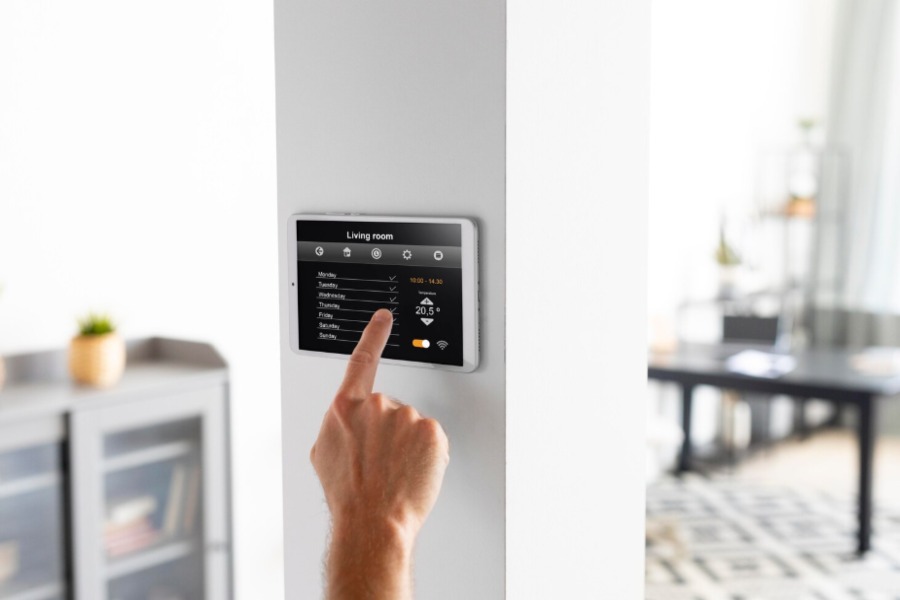
Indoor air quality programs have changed. Traditional smoke detection remains essential for fire protection, but it does not provide a complete picture of the air people breathe every day.
Modern buildings face new indoor air challenges. Vaping, volatile organic compounds (VOCs), carbon dioxide buildup, and fine particulate matter can all affect occupant health, comfort, and productivity. These contaminants often appear long before a fire alarm would activate.
As commercial buildings become smarter, indoor air monitoring must move beyond smoke detection alone.
Smoke Detection Has Clear Limits
Smoke detectors are designed to identify combustion products generated during a fire. Their purpose is life safety, not environmental monitoring.
Many airborne contaminants never reach the threshold needed to trigger a smoke alarm. Vape aerosol is one example. Electronic cigarettes generate an aerosol rather than smoke through combustion. While the visual cloud may disappear quickly, microscopic particles and chemical compounds can remain suspended or settle on indoor surfaces.
The U.S. Environmental Protection Agency states that secondhand aerosol from electronic cigarettes can contain nicotine, formaldehyde, and metals, and ventilation alone cannot fully eliminate exposure.
This gap has created demand for dedicated environmental sensing technologies, including vape detectors, that identify vaping events without relying on smoke detection principles.
Modern Air Monitoring Uses Multiple Sensors
Advanced indoor air monitoring systems collect data from multiple sensing technologies simultaneously.
Rather than measuring a single parameter, they combine environmental inputs to improve detection accuracy.
Common measurements include:
- 5 and ultrafine particulate matter
- Carbon dioxide (CO₂)
- Total volatile organic compounds (TVOCs)
- Temperature and humidity
- Occupancy trends
- Vape aerosol signatures
These measurements work together. Elevated particulate counts alone may indicate cooking or cleaning activities. Combining them with VOC patterns, humidity changes, and proprietary detection algorithms produces more reliable event classification.
This multi-sensor approach reduces false positives while giving facility managers actionable information instead of isolated readings.
Real-Time Detection Improves Building Operations
Indoor air quality is no longer managed through scheduled inspections alone.
Modern systems stream environmental data continuously. Building operators receive alerts within seconds of abnormal conditions. This allows faster intervention before contaminants spread through occupied spaces.
Real-time monitoring supports several operational goals:
- Faster response to indoor air events
- Improved HVAC optimization
- Better ventilation scheduling
- Reduced occupant complaints
- More accurate compliance reporting
Instead of increasing outdoor airflow continuously, facilities can adjust ventilation based on actual environmental conditions. This improves energy efficiency while maintaining healthier indoor environments.
Data Creates Better Facility Decisions
Continuous monitoring also builds a historical record.
Trend analysis helps identify recurring issues that periodic inspections often miss.
Examples include:
- Repeated vaping incidents in specific restrooms
- Seasonal ventilation deficiencies
- Areas with persistent VOC accumulation
- HVAC performance degradation
- Occupancy patterns affecting indoor air quality
Historical datasets allow facility managers to prioritize maintenance investments using measurable evidence rather than assumptions.
The same environmental data can also integrate with building management systems, security platforms, and maintenance software to automate responses.
Indoor Air Quality Is a Workplace Issue
Poor indoor air affects more than building systems.
It influences employee wellbeing, visitor experience, and operational performance.
The EPA notes there is no safe level of exposure to secondhand tobacco smoke, and smoking or vaping indoors can release harmful chemicals into enclosed spaces. Even advanced ventilation and filtration reduce exposure but do not completely eliminate it.
For organizations responsible for schools, healthcare facilities, offices, hotels, and commercial buildings, monitoring airborne contaminants has become part of broader risk management.
Building owners increasingly view indoor environmental quality as an operational metric rather than simply a maintenance concern.
The Future Extends Beyond Fire Safety
Smoke detectors remain indispensable for life safety. They are not designed to monitor the full spectrum of indoor air contaminants.
Modern facilities require broader environmental awareness.
The next generation of indoor air monitoring combines intelligent sensing, continuous analytics, and automated building controls to detect risks that traditional fire systems cannot identify.
As building technologies continue to evolve, indoor air monitoring is becoming a core component of facility management. Organizations that invest in comprehensive environmental sensing gain better visibility into air quality, stronger operational data, and healthier spaces for occupants.
One statistic highlights why this matters. According to the U.S. Environmental Protection Agency, secondhand tobacco smoke contains more than 7,000 chemicals, reinforcing the importance of monitoring indoor environments beyond visible smoke alone.