
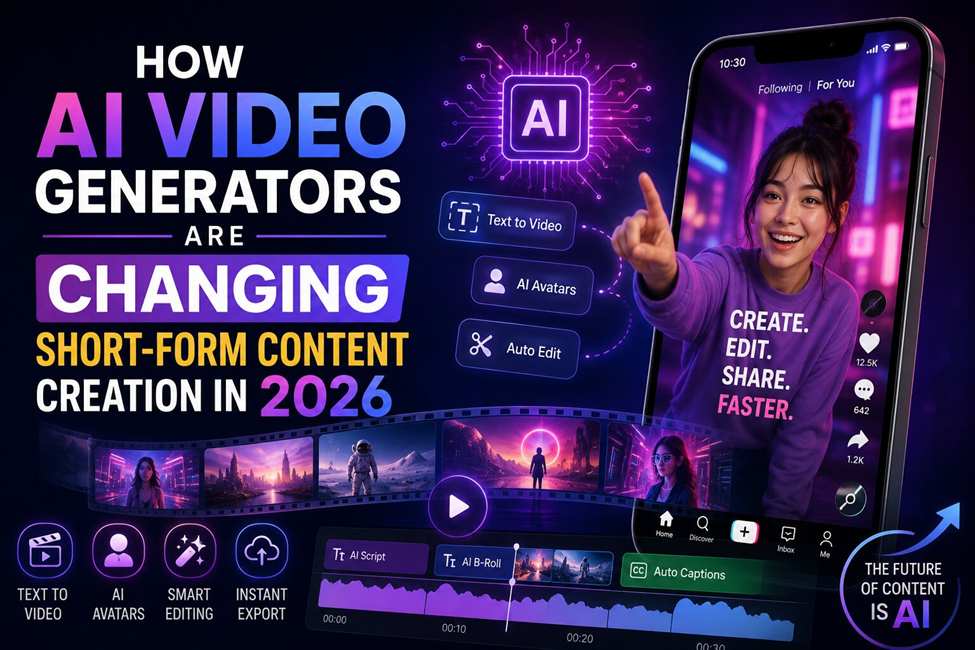
Short-form video has always rewarded speed — whoever can turn an idea into a finished clip fastest tends to win the algorithm. In 2026, AI video generators have collapsed that turnaround from days to minutes, and in doing so they’ve reshaped who gets to make video content at all. What used to require a camera, an editor, and a production calendar can now start with a text prompt. The result isn’t just faster content — it’s a different creative process altogether, one where ideation and iteration matter more than technical production skill.
Production Timelines Have Collapsed
The clearest shift is speed. Vertical, under-60-second clips now account for the majority of AI-generated video output, and the average marketing clip runs around 40 seconds — short enough that creators are rethinking structure entirely. There’s no room to ease into a story; the first few seconds have to hook the viewer or the rest doesn’t get watched. That’s pushed creators toward a “hook first, everything else second” production order, writing the opening line before anything else exists.
Studios are feeling this too. Larger production teams applying AI-assisted workflows to short-form projects have reported cutting timelines from months down to weeks, largely by letting AI generate scene variations for human editors to select from and refine rather than building every frame from scratch. It’s less “AI replaces the editor” and more “AI gives the editor more options to choose between, faster.”
From Repurposing to Original Generation
Two distinct workflows have emerged. The first is repurposing: tools that take long-form video or audio — a podcast, a webinar, a livestream — and automatically identify the clip-worthy moments, reframe them for vertical formats, and add captions. This has become the backbone of high-volume content strategies, where a single hour-long recording gets turned into a dozen platform-ready shorts without a human touching a timeline.
The second is generation from scratch: text-to-video and image-to-video tools that create footage with no source material at all. Text-to-video is still the dominant entry point, but image-to-video is growing fast among creators who want more control over how a scene starts — feeding the model a reference image rather than hoping a text prompt lands on the right look. Visual consistency across scenes — keeping a character or product looking the same shot to shot — has gone from a differentiator to a baseline expectation.
Narrative Formats Are Moving Into Apps Built Around Characters
One of the more interesting developments in 2026 is how short-form AI video is showing up outside traditional content platforms altogether — inside apps built around ongoing characters and relationships, where a video isn’t a standalone clip but part of a continuing story. AI companion apps have started producing serialized short-form video tied to individual characters, complete with recurring arcs and continuity that carries back into ongoing conversation.
Candy AI’s approach is a good example of where this is heading. Beyond on-demand clip generation, the platform has rolled out pre-produced, scripted video “Shorts” and “Episodes” attached to individual characters — short, sequential clips that build on each other rather than existing as one-off generations. Call Your Girlfriend’s breakdown of how Candy AI’s videos, Shorts, and episodes actually work is worth a look for anyone curious how this format functions in practice — including how the token economy behind it works, and where the line sits between “interactive” in the marketing sense and interactive in the literal, choose-your-own-outcome sense.
It’s a useful case study for the broader trend: short-form AI video is increasingly less about isolated clips and more about continuity — content that remembers what came before it and references it later, whether that’s a brand maintaining a consistent visual identity across a campaign or a character remembering an earlier scene in a later conversation.
Authenticity Has Become a Deliberate Feature
As AI-generated video has gotten cheaper and more common, a counter-trend has emerged: audiences increasingly reward content that visibly shows a human behind it. Platforms have started rolling out ways to flag creator involvement in AI-assisted videos, and early data suggests videos with visible “human touch” indicators hold attention noticeably longer than fully automated ones. Some creators are responding by leaving in the imperfect cut, the raw reaction shot, or the visible behind-the-scenes moment — signals that used to be edited out are now being kept in on purpose.
That tension — AI making high-volume production possible while audiences simultaneously crave evidence of a real person — is likely to define the next phase of short-form video more than any single new tool or model release.
What This Means for Creators
A few practical shifts are worth planning around:
- Volume alone isn’t a strategy. With AI removing most of the production bottleneck, the differentiator in 2026 is a clear point of view, not output count. More forgettable video is still forgettable video.
- Structure has changed. With attention spans built around a hook-payoff-reason-to-stay format compressed into under a minute, scripts need to be written back-to-front — hook first.
- Repurposing and generation are complementary, not competing. The most efficient creator workflows in 2026 tend to use repurposing tools for high-volume distribution and generation tools for original concepts that don’t yet exist as source footage.
- Continuity is becoming a differentiator. Whether it’s a brand’s visual identity across a campaign or a character’s ongoing story across episodes, formats that build on themselves over time are outperforming one-off clips.
Short-form video was already the fastest-growing content format going into 2026. AI video generators haven’t changed that trajectory so much as they’ve removed most of the friction standing between an idea and a finished clip — which means the real competitive edge has shifted from “can you produce it” to “do you have something worth producing.”